Idaho Looks to Boost CSR through Benefit Corporation Legislation
BLOG
BLOG

While we’re a Boise advertising agency, we have national clients who work with us because of our expertise in corporate social responsibility and purpose-driven branding. We’re also part of a growing national movement to merge social and environmental performance along with financial success.
The movement to enact Benefit Corporation legislation is just one more sign of the burgeoning importance of corporate social responsibility to companies, consumers, communities—and governments.
Here in Idaho, the state legislature is currently considering joining this movement to give self-selecting corporations the right to legally create social impact and address environmental issues as part of their bottom-line and corporate charter. Thus far, twenty-seven states have now passed Benefit Corporation legislation, and another 14 are actively working on passing it.
A Benefit Corporation is a relatively new class of corporation, along with the more established forms of Limited Liability Corporations (LLCs), C Corporations, and S Corporations are.
Benefit Corporations are a specific class of corporation that is required to create a material impact on society and the environment. In this legal structure and operating model, corporate boards are given the flexibility to consider people and planet alongside financial profit in determining a company’s strategy and success.
Many get confused between Benefit Corporations and certified B Corps. The former is a legal status, like the more established forms of Limited Liability Corporations (LLCs), C Corporations, and S Corporations. B Corps embrace the same principles as Benefit Corporations, but undergo a certification to meet rigorous standards of social and environmental performance, accountability, and transparency
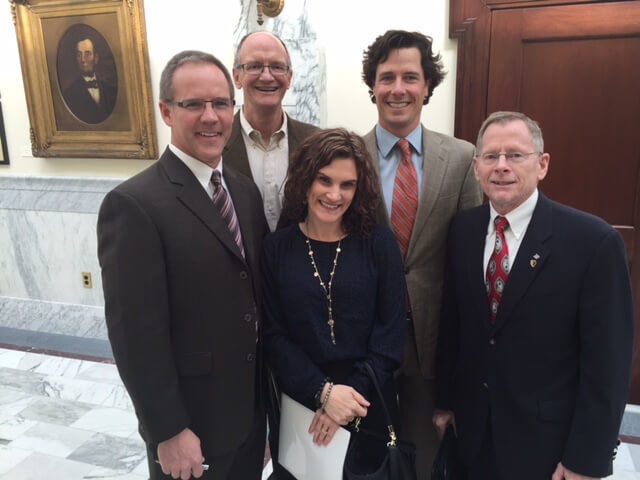
L-R Front: Steve Dowd, Jitasa; Lisa Fisher, social entrepreneur; Mark Buchannan, Boise State University College of Business and Economics);
L-R Back: Russ Stoddard, and Decker Rolph, Treefort Music Fest
A Benefit Corporation is a relatively new class of corporation, along with the more established forms of Limited Liability Corporations (LLCs), C Corporations, and S Corporations are.
Benefit Corporations are a specific class of corporation that is required to create a material impact on society and the environment. In this legal structure and operating model, corporate boards are given the flexibility to consider people and planet alongside financial profit in determining a company’s strategy and success.
Many get confused between Benefit Corporations and certified B Corps. The former is a legal status, like the more established forms of Limited Liability Corporations (LLCs), C Corporations, and S Corporations. B Corps embrace the same principles as Benefit Corporations, but undergo a certification to meet rigorous standards of social and environmental performance, accountability, and transparency.
For instance, Oliver Russell is a certified B Corp—and an LLC. If and when the State of Idaho enacts Benefit Corporation legislation, we will undertake the process to convert our legal corporate status to a Benefit Corporation.
I recently had the opportunity to provide testimony in support of Benefit Corporation legislation to the Idaho State Senate Commerce Committee. Our team of advocates (Entrepreneur Lisa Fisher, Decker Rolph of Treefort Music Fest, Mark Buchannan of Boise State University College of Business and Economics, and Steve Dowd of fellow B Corp, Jitasa) presented the case for Benefit Corporation and it passed the commerce committee with a unanimous vote. It was subsequently passed by the full Senate and now moves on to the Idaho House of Representatives. (Editor’s note: Since this blog was originally written, the plan was unanimously endorsed by the House and is now on to the Governor’s desk for signature into law!)
Testifying before state senators comes with its own set of formal protocols and is an interesting and rewarding experience. I thought I would share the testimony I presented to the committee—you can find it below.
You can also learn more about Benefit Corporation legislation on the movement’s national advocacy site. We’ve published educational article about B Corps on our blog, as well as a review of The B Corp Handbook by Ryan Honeyman, an excellent informational resource.
Here’s my testimony in support of S 1076, Idaho Benefit Corporation Legislation:
Chairman and Committee Members,
My name is Russ Stoddard, president and owner of Oliver Russell, and I support S 1076, Idaho Benefit Corporation Legislation.
My company, Oliver Russell is a brand-marketing firm and has been conducting business from our Boise headquarters since 1991. While I was born just over the state line, my parents are from Challis and Salmon, and I have worked and lived in Idaho since 1980, beginning my career as a river guide. In fact, I once had the pleasure of guiding Senator Winder and his family on a trip down the Middle Fork of the Salmon River. That was a long time ago.
My wife, Sarah, checks the ingredients of nearly every food product she purchases. Increasingly, people are doing the same thing with companies. They do this by asking questions such as these: How is the company working to improve our community? How does the company treat its employees? The environment? Consumers are looking for better, more meaningful corporate ingredients, and they are voting with their dollars based upon the company’s performance in these areas. And in the hunt for the best and the brightest, prospective employees are making career choices on where to apply their time and talents based upon the same fundamental issues.
The best way for companies to address this demand from the marketplace is to bake these values into their company’s DNA. My company, Oliver Russell, has elected to do this by becoming a certified B Corporation. In order to qualify as a B Corporation, we have to meet rigorous standards of social and environmental performance, accountability, and transparency. It's the best way I’ve found to display our ingredients to our clients, employees, suppliers, our community and other constituencies.
This has been a competitive differentiator and a profit contributor for us. We have companies choose to do business with Oliver Russell because our values align with theirs. I also probably receive at least one email a day from a prospective employee who is looking specifically to work at a firm like ours. And when we monitor and measure our energy usage, we find ways to reduce our associated costs, which is a direct contributor to profits.
I believe the best way to enable companies to address this demand from the marketplace is for the state to give business owners the latitude to choose a legal structure that lets us create the type of company we want—and that our customers and employees are seeking. I believe that the Benefit Corporation Legislation before you is the best way to accomplish this.
Don’t mistake for a minute that this legislation isn’t about profit. You don’t succeed in business for nearly 24 years—as I have—without paying attention to the bottom line. Or as we like to say, “No margin, no mission.” It’s just a different way of delivering profit and one that makes our state and our businesses more competitive. In our case at Oliver Russell, this includes contributing nearly $1.8 million in cash and services to more than a hundred nonprofits in the state of Idaho over our history. These grants have gone toward initiatives ranging from youth development and education to community farming efforts—and everywhere in between.
And a quick guesstimate I made this morning is that our small business—just one business—has conservatively contributed more than $15 million to the payrolls of Idaho over our company’s history as well. It all adds up.
Our businesses and our state can become more competitive by providing the voluntary option of Benefit Corporations. By giving entrepreneurs and business owners the freedom to consider other factors in addition to profit when operating their businesses, you can encourage new economic development in Idaho without financial cost to the state.
I urge you to support Benefit Corporation legislation. It can help Idaho build homegrown companies and also attract new businesses, jobs and investments from elsewhere. I seek your “aye” vote on S 1076.
Thank you.
Blog
We chronicle 12 months of measurable impact in our first public benefit report.
Blog
A commitment to public benefit puts real meaning into our legal charter.
Blog
A movement of certified badass companies uses business to solve social issues.