Our Social Corporate Responsibility Journey Leads to a New Legal Status
BLOG
BLOG

We have some big news to share—we are officially Idaho’s first benefit corporation and, for the time being, Idaho’s only benefit corporation.
It was a long time coming.
Russ makes our benefit corporation status official.
For 24 years we’ve had social responsibility at the center of our values system. What this amounted to for the first two decades of our history was mostly making contributions to nonprofit causes in our community—almost $1.8 million in cash and donated pro bono services to this point.
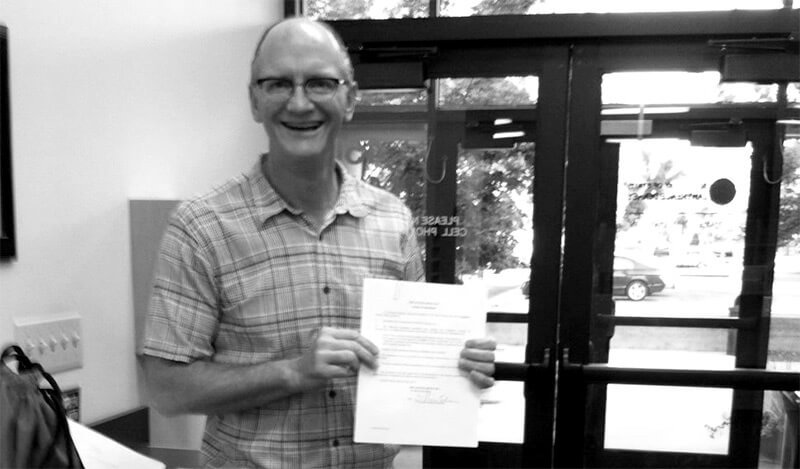
Russ makes our benefit corporation status official.
Four years ago, we took another big step along the sustainability curve by becoming a certified B Corporation (which is often interchanged with benefit corporations, but is different; in their most basic form, benefit corporations are a legal corporate entity, like a C Corporation, while B Corps are companies whose social impact is certified through an assessment process.)
About a year and a half ago, we repositioned Oliver Russell in the marketplace to build brands for purpose-driven companies and organizations that have a product, service, or business model that benefits society or the environment. Now, 70 percent of our client companies fall into the category of those who use the power of business to solve social and environmental problems.
And today, we’re Idaho’s first benefit corporation—the first of what we hope will be many, many to come.
The Idaho Benefit Corporation Act was passed this spring by the Idaho Legislature and signed into law by the Governor, effective July 1, 2015. As of this writing, 30 states and the District of Columbia have enacted benefit corporation legislation into law.
Benefit corporations are a new legal class of corporation that voluntarily meets higher standards of corporate purpose, accountability, and transparency. They have a corporate charter to create a material positive impact on society and the environment. Benefit corporations are required to not only consider shareholders in their decision-making and operations, but also take into account workers, community, and the environment. In addition, Idaho benefit corporations must prepare an annual benefit report detailing and measuring the results of their pursuit of public benefit, as well as undergo a third-party assessment of their overall social and environmental performance.
What this really amounts to is an evolution on the concept of “sustainability.” Where once sustainability was primarily about a company’s environmental policies and performance, it’s now been extended to include social and financial performance. That last measure—financial—is especially important to remember, as this isn’t about a nonprofit, it’s about delivering a profit based on these new fundamentals. As we are wont to say, “No margin, no mission.”
So you can see how it’s easy to confuse benefit corporations with B Corps, as both inhabit the same family tree of social corporate responsibility.
As mentioned earlier, Oliver Russell is also a certified B Corporation and currently employs the nonprofit B Lab to perform a third-party assessment of its impact on workers, the community, and the environment. Earlier this year, we were gratified to be included on the “B Corp Best for Workers” list honoring businesses that earned a worker score in the top 10% of more than 1,200 Certified B Corporations around the world.
In our minds, building brands for purpose-driven companies goes beyond plying our storytelling, advertising, and image-building strengths on behalf of our clients. We’re also on a mission to enlist other companies in the movement. Interested in learning more about how businesses can have a public benefit? If you have questions about either benefit corporations or B Corps, we’d be happy to talk with you about it.
Read more about our role enacting benefit corporation legislation in Idaho.