The Glory of a Social Entrepreneur
BLOG
BLOG

In another world, Curt Bowen—whip smart, driven, and charismatic—could have been a hedge fund manager raking in the big bucks on Wall Street.
But on this humid, tropical day in rural coastal Guatemala, we find him, shirt soaked in salty brine, pant legs and boots splattered in mud, managing not millions, but rather a hedgerow grown from chaya, the Mayan miracle plant.
“We’re trying to reintroduce chaya as a high-protein ingredient for use in cooking,” said Bowen, squinting through the sting of sweat in his eyes. “It’s easy to grow, already in use, and we’re hoping to repurpose it as a convenient way to add protein to diets.”
Ah, the glory of a social entrepreneur in the third-world, a tad bit different than that of a cubicle-dwelling #socent in Silicon Valley.
The badge of being a social entrepreneur gets bandied around a lot these days. It is derived from the term “social entrepreneurship,” which Bill Drayton, founder and CEO of Ashoka, coined in 1981 as a way to describe “individuals with innovative solutions to society’s most pressing social problems. They are ambitious and persistent, tackling major social issues and offering new ideas for wide-scale change.”
Like anything, you can find any number flavors of social entrepreneur, from techno-pups (read: teenagers) developing mobile apps to end homelessness to living, breathing walking ones wearing muddy boots and working the wilds of Africa.
Bowen is about as good a model for a social entrepreneur as you can find. Reared on an organic farm in Idaho, he’s a co-founder of Semilla Nueva, an NGO that is working to change the agricultural development system in Guatemala, and recognized as an Ashoka Fellow by the institution that gave social entrepreneurship its name.
“Whether you’re a business entrepreneur or one who’s trying to create social impact, you have to be visionary yet extremely practical,” says Bowen. “You have to work long and hard with little payoff, and you need the wisdom to pick the right goal and then develop the discipline to keep at it, year after year, as you try to find success.”
Sounds a little bit like a lean-startup guy, wouldn’t you say?
Bowen helped start Semilla Nueva, or “New Seed,” in 2010 as a project to sell organic fertilizer. Of course, six years is an eternity for a startup and true to its social entrepreneurship roots, Semilla Nueva has pivoted several times since its founding. It’s now positioned in the marketplace as an NGO that combines sustainable, research-based agricultural technologies with experiential insights and farmer-to-farmer education in an attempt to improve the livelihoods of rural communities.
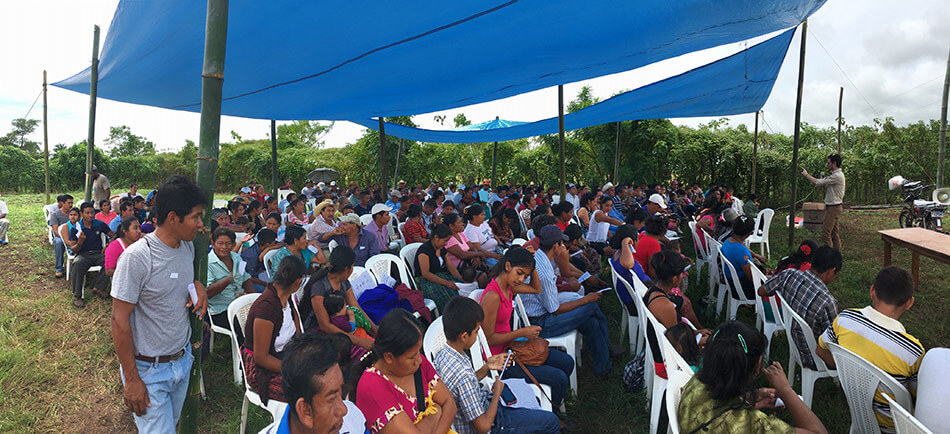
Curt Bowen talks to a gathering of farmers in Guatemala
And right now, just as Bowen and Semilla Nueva are beginning to taste success and deliver results in rural Guatemala, they are considering yet another pivot, one of potential national consequence, but not without its risks. We’ll get to that in a moment.
Today, Bowen and his team are working in an intense and vertically integrated way in the Departments of Retalhuleu and Suchitepequez the Pacific Coastal region of Southern Guatemala.
The effort in these areas is built around research, education, and relationship building—all of which are earning Semilla Nueva valuable street, err, farm cred in the region.
On the education front, Semilla Nueva is teaching farmers about no-till crop planting for soil building and fertilizer retention—which both have the potential to create higher yields and save on fertilizer costs. These advancements are typically conveyed to farmers through a network of Semilla Nueva-organized “promoters,” Guatemalans who are farmers themselves and who are trusted in the communities to provide the unvarnished truth.
Bowen’s team is also implementing a Harvard-backed research study with infants from birth to two years of age whose growth is tracked to gauge the effects of consuming high-protein corn (called QPM, short for quality protein maize) in a country that has the highest malnutrition rate in the Western Hemisphere.
At the same time, Semilla Nueva is wading deep into the field of agricultural products, helping to test biofortified rice for planting in low-lying fields too wet for other crops; new strains of sesame, an important cash crop; and a new variety of nutritious pigeonpea, or gandul, a nutritious bean that can be planted between rows of existing crops as a way to expand resources and rebuild soil.
The project that comprises a fork in the road is the development of biofortified foods and new seed strains, including an upstart variety of QPM.
Corn comprises most of the daily diet for rural Guatemalans. QPM is corn seed that is vastly more nutritious—critical in a country where up to half the caloric intake is from corn and where in some areas as much as 90% of the population is malnourished.
So far, Semilla Nueva’s research with QPM and other biofortified foods has delivered promising results.
“This is a big idea that if executed properly could help end malnutrition in Guatemala,” Bowen says.
And therein lies a startup question not unfamiliar to any entrepreneur, whether financial or social—should Bowen pursue deep success in narrow vertical markets or try to scale rapidly across the broad market?
On the one hand, Semilla Nueva has gained credibility, momentum, and traction in the two rural departments through a research-based approach built upon hard-earned relationships. The end result here could be the creation of model sustainable farming communities that could then be the template for other rural departments in Guatemala.
And on the other hand is broad scale, monumental change—an honest-to-goodness Big Hairy Audacious Goal (BHAG) that could be a critical tool in lifting an entire country out of malnutrition, a health crisis that plagues nearly every aspect of Guatemalan life, from the health of its citizens to the prosperity of its economy.
Of course, all this BHAG requires is that a small NGO with limited resources, one that’s led by a gringo, will be able to develop new political finesse and marketing moxie as it negotiates a thicket of established behaviors and sensitive partnerships with farmers in different departments, citizen sector organizations, and a government that historically has been known for its corruption.
But, hey, that’s all in a day’s work for any entrepreneur, right?
“This will be my board’s big strategic decision in 2016—to continue iterating on our work in these departments where we’ve built relationships around learning and are experiencing success—or to go for it on a national scale and try to eradicate malnutrition in Guatemala,” says Bowen.
We’ll be paying close attention to Semilla Nueva’s strategic direction this year, but in the meantime, if you were a social entrepreneur walking the fields of Guatemala in Bowen’s muddy boots, what would you be inclined to do?
Blog
A volunteer service trip brings meaning and more to your vacation.
Blog
Russ talks 'How to Build a Purpose-Driven Company' with host, Tony Loyd.
Blog
Another type of rapid career prototyping.