An Innovative Approach to a University's Sustainability Report
BLOG
BLOG

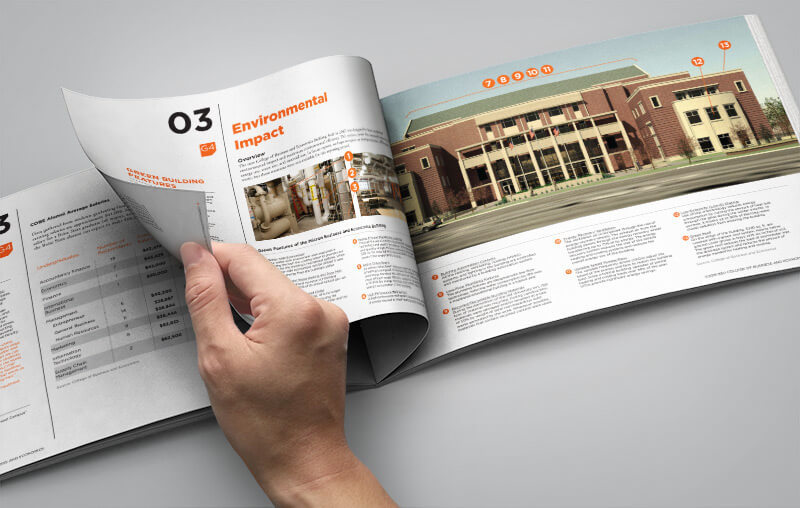
Newsflash: Social responsibility isn’t limited to corporations.
Sustainability initiatives are a big deal on college campuses these days. Like other colleges and universities, Boise State University is a living, breathing (and thinking) organism. With 23,000 students and 2,400 faculty and staff, it generates a significant economic, environmental, and social footprint.
So we were excited last winter when representatives from Boise State University’s College of Business and Economics (COBE) proposed a project to us—a collaboration of sorts. They intended to produce their first sustainability report, the equivalent of an environmental impact assessment for a university, but broader because it includes social, economic, and other measurements. They wanted assistance with the design of the inaugural publication from a purpose-driven brand agency, and inquired about the possibility of leveraging one of our Call to Action Grants (formerly called Social Impact Grants).
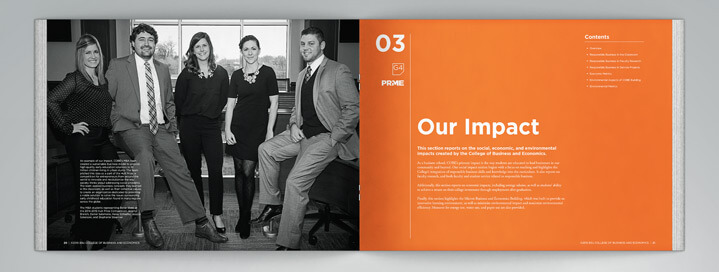
To be frank, this project sounded like an exercise in patience—working with compiled content from 15 student reporters, editing the 60+ page copy doc for consistency and clarity, and completing the work on a tight timeline with a tight budget doesn't sound like the makings of an efficient project—but the goal was worthy and gave us an opportunity to increase our own community impact. We awarded them a Grant, and the project turned out to be an inspiring (and fun) way to help further support the responsible business movement in Idaho.
The report was led by COBE’s Responsible Business Initiative (RBI) Director, Angeli Weller, and Graduate Intern, Taylor Reed. Both women are passionate about the ability and responsibility of an institution, whether it be a business or a university, to make positive change—and they kept that goal in sight at all times throughout our collaboration to prepare a report that openly accounts for the College of Business’s social, economic, and environmental impacts on its key stakeholders.

They suggested an innovative approach to their report: a combination of two different reporting parameters—the UN’s Principles for Responsible Management Education (PRME) guidelines, a framework specific to colleges and universities, along with the Global Reporting Initiative (GRI) framework, the leading guidelines used by businesses and corporations. UNPRME allows for a qualitative and narrative approach to sharing a university’s goals and aspirations—while the GRI framework is more quantitative, data-driven, and well...harder. As a university trying to complete their first assessment, it would have been an attractive prospect to ‘settle on’ the PRME requirements. Instead, COBE decided to push itself, and its students, and provide a more credible real-world experience for their reporters with a more demanding, research-driven approach.
COBE made sure that learning was at the heart of the effort: 15 student sustainability reporters researched, collected data, and wrote the report, and three spring 2015 COBE classes contributed additional expertise—including a graduate accounting class that conducted the report’s assurance review.
“Our team of student sustainability reporters began this project with two frameworks, the feedback of roughly 50 key stakeholders and the chance to produce a sustainability report from scratch, with no real limits,” said MBA student and project team leader Taylor Reed. “We have developed a valuable skill set that we can share with future employers and continue to build on long after we leave the college. I couldn’t be more proud of the outcome, and with the benchmark our team created not only for the college, but for future sustainability reporting on university campuses across Idaho.”
The mission of the Responsible Business Initiative is to catalyze leaders to produce sustainable value for business and society, and this report is one way that value is demonstrated. “As a College of Business and Economics, we need to be running our own organization in a way that models the leading business and economic practices we research and teach,” said Dean Ken Petersen. “That’s one of the reasons we produced this report—to demonstrate how to measure and transparently communicate our significant economic, social, and environmental impacts, just as we’d expect businesses in our local and global communities to do.
COBE plans to publish its next report in the spring of 2016 to benchmark its social, environmental, and economic impacts year over year, to fill in as many of the measurement gaps as possible, and to keep the college focused on continuously improving its overall performance. We hope to help them.
Check out COBE’s Sustainability Report here.