Tick Talk: Shinola's Branding Dilemma
BLOG
BLOG

Detroit’s had a hell of a time. Bankruptcy, mass-migration of industry, urban decay, housing collapse—you name it, Detroit’s been through it. And it appears it might actually get through it. But that’s another story.
At Oliver Russell, we’re about cause-minded people, places, and products. Our purpose-driven branding agency ferrets out the good guys and keeps a soft spot for the underdog. And if ever there was an underdog, Detroit is it. The Motor City is the epitome of the scrappy prizefighter—bruised but not beaten, down but not out.
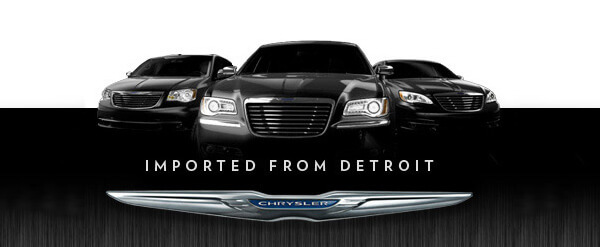
While we’re not one to jump on the bandwagon, it’s cool to root for Detroit these days. It’s even cool to be from Detroit; who remembers Chrysler’s “Imported from Detroit” ad campaign? The tagline, the gritty Super Bowl commercial, the city’s skyline etched into the floor mats—it was memorable and it smacked of sincerity and respect.
Now there’s a new(ish) kid on the block celebrating the city. This time the product isn’t branded a Detroit import, it’s “Built in Detroit.” To most, it’s a genuine salute to the city. To others…
Back in 2012 I got wind of a socially minded Detroit startup called Shinola. The name alone got my attention; Shinola is both a shoe polish and a way of determining someone’s basic intelligence. Then I learned their plan was to manufacture high-quality, precision timepieces, a market long ago ceded to the Swiss and the Japanese. Since when did Detroit make watches? And who was going to make them—displaced autoworkers?
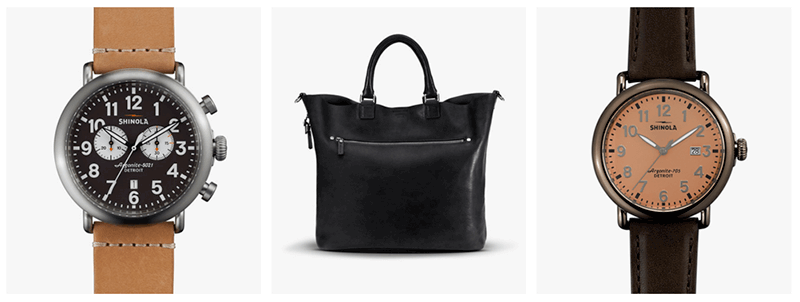
Turns out that’s exactly who makes these fine, fine watches, and it’s part of Shinola’s allure. After cutting their teeth on timepieces, Shinola now turns out high-end bikes, wallets, belts, bags, journals, knives, pens—all made in America, by an American workforce, and sourced (mostly) from American suppliers. Scrappy.
The idea really wasn’t so farfetched. Making a watch is very much like making a car: tight tolerances, lots of moving parts, everything needing to be pieced together just right. Some of the original Shinola employees had experience making cars, but none of them had ever made watches. Turns out, they were a natural fit.
“People keep telling us how much Shinola has done for Detroit,” Shinola’s Chief Executive Steve Bock told The Washington Post. “But it’s the absolute opposite: it’s what Detroit has done for Shinola.”
The plan was simple: gather a team of former autoworkers, train them using personnel from Swiss watchmakerRonda, station them in Detroit’s storied Argonaut Building, start cranking out luxury timepieces. You see? Simple.
That simplicity is by design, and part of the brand’s allure. Take a gander at their products and the first thing you might think is “retro.” But that’s not it at all. The watches—and everything Shinola makes—go for a timeless, classic look.
“The only thing that's vintage or retro about the brand is the name,” Shinola Creative Director Daniel Caudill told Adweek. “Things that never go out of style, that's what we're trying to create.”
All sounds pretty cool, right?
Turns out not everyone buys into Shinola’s branding or it’s gritty Detroit mystique. I’ll admit this isn’t the piece I originally set out to write. At first blush, I did see Shinola as Detroit’s “corner man,” urging that scrappy prizefighter to get off the ropes and come up swinging. And then I started reading.
“Turns out not everyone buys into Shinola’s branding or its gritty Detroit mystique.”
In 2013 The New York Times gave it to Shinola good, utterly quashing its “social-good” aura and eviscerating founder Tom Kartsotis. Times author Tom Caramanica called Kartosis “a mid-price watch mogul looking to go luxury under the cover of charitable business practices.” Ouch.
For those who don’t know, Kartsotis was an executive at Fossil prior to founding Shinola, and he’s got a knack for tugging at consumers’ heartstrings and inspiring that “aw shucks, ain’t this grand” feeling. His holding company, Bedrock Manufacturing, also owns Filson, a maker of high-end outdoor gear and bags. That “Filson feel” is very similar to Shinola: quality, integrity, classic, craftsmanship. And just like Shinola, Filson products don’t come cheap.
Recently, questions have surfaced around Shinola’s “all-American” story and brand. It’s caught the attention of bloggers, the mainstream media and even the Federal Trade Commission, which recently cracked down on one watchmaker’s “Made in America” claims. That got Shinola’s attention. Mine, too.
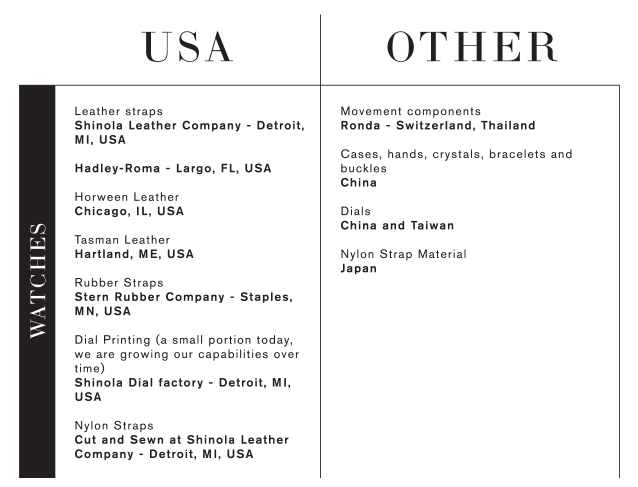
To their credit, Shinola has tried to be transparent about where their stuff comes from. A handy chart on their website shows where much of the product is sourced and manufactured. But it isn’t super easy to find. From the homepage head to Customer Service, then to General Resources (where anyone would expect to find such a chart, right?), then to the FAQs, then dig around in there for a while. Once you find the chart you’ll notice the watches’ actual guts (the movement) are made in Switzerland and Thailand, and the dials, crystals, etc. come from China. Perhaps this is why the “homegrown” branding isn’t resonating with everyone.
In a particularly stinging article on FourPins.com, author Jon Moy claims Shinola is “using my city as its shill, pushing a manufactured, outdated, and unrealistic ideal of America.” Moy calls the company “Detroit’s misguided white knight,” and regards their corporate largesse as “nothing more than a sales pitch.
Not if Shinola has anything to say about it. They’re moving ahead with fancy retail stores, and they’re vigorously defending how and where their products are made.
In a statement given to the Detroit Free Press, the company wrote: "While we do import certain components of our watches, it requires the skill…of hundreds of local employees at our Detroit factory to carefully construct each watch.” Shinola President Jacques Panis offered up a nuanced defense of his company, saying “This is building. For us, it’s not assembling.”
While that certainly sounds like splitting hairs to me, Shinola is sticking to its story and attempting to maintain transparency around its supply chain. Remember Ronda, the Swiss firm that provided the original crews’ training? They’re featured prominently in a video on Shinola’s website. In the video, Ronda’s Head of Technical Services Hanspeter Herzog is very clear that “all the components are produced in Switzerland,” then assembled in Detroit.
“It’s like on a car,” Herzog says, “it’s only a good car if everything is good quality, and assembled the right way. We can bring the knowledge, but the people are still the most important element.”
And that’s ultimately what Shinola is selling: its story and its people.
Shinola’s filled with plenty of PR pros and people that know their business. However…
Either they didn’t see this backlash coming or, when they did, they simply weren’t prepared for it. The videos on the site are great—stirring, even. More of that, please. The supply-chain chart is a good stab at transparency. Why not bubble it up to the surface on the website? You gave jobs to displaced auto workers—terrific. What else have you done for Detroit? How about a Community section on the website showing recent volunteer or philanthropic efforts?
This is a company that needs to show—right now—that they’re more than a marketing gimmick. I searched the web for news of recent Shinola largesse and came up empty. Apart from questions around homegrown manufacturing, the only recent news concerns the company’s latest retail outlets. These, too, bring controversy. Beyond Shinola’s wares, the stores stock other high-end, niche products. In short, stuff the working stiff/displaced auto worker could never afford.
So who’s buying it? Former President Bill Clinton, for one. Clinton owns over a dozen Shinola watches and effused, “We need more American success stories like Shinola in Detroit.” And regardless of how you feel about Shinola’s story and brand, they are a success. They took a historic building and turned it into a high-tech manufacturing center. They took a long-abandoned craft and brought it back to American shores. And they took a lot of cast-off workers, gave them jobs, and put them through highly specialized training.
That’s the story of Shinola, and that’s no shit.
Blog
Branding Magazine brings together four experts to discuss purpose-driven branding.
Blog
Say what you will about these candidates, but you can't argue with their brand power.
Blog
How a dancing acorn became the face of the Green Team.