B2B Marketing is Being Influenced by Intentional Corporate Values
BLOG
BLOG

We’ve written about the importance of corporate values before (How Much Value is there in Values?), primarily their worth as a strategic foundation for the brand, a driver for morale and motivation of employees, and—when they are communicated into the marketplace—a differentiator for consumers who increasingly include this in their purchasing decisions.
We also predicted that values would be on the rise as a factor in determining relationships in the business-to-business (B2B) segment of the economy.
What we didn’t foresee was how quickly this would come to pass—at least for our own business—or the relative weight that would be placed upon aligned values in the B2B decision-making process.
So far in this young year, we’ve had three companies approach us about working together—specifically because our values (social and environmental) align with theirs.
These aren’t your traditional companies. They’re all startups that represent a new breed of company. One is a public benefit corporation. Another is a certified B Corporation. And the other intends to certify as a B Corporation in the next 1-2 years.
They compete in the consumer packaged goods, financial services, and Software-As-A-Service (SAAS) sectors of the economy.
None of them are in Idaho, where we’re based, so they had to actively search us out.
Now I’ve always felt that in new business, you had to have the skills and experience to get the job. (And a good dose of chemistry, but that’s another story.) You lead with your abilities and knowledge, and once those are clearly ascertained by a client, then values can provide a compelling lift, both in shared purpose and to the working relationship—kindred spirits working toward meaningful objectives, I’ve found, deliver better results.
But my thinking has totally been upended this year. One prospective client, a well-funded renegade in its industry category, flat out told us their first priority was that their values were in alignment with those of the marketing firm it hires. “Skills,” followed by “experience,” trailed values.
I’ve got a hunch what you’re thinking about these values-first companies. Startups. Youthful exuberance. Rose-colored glasses and red ink and a train wreck down the road. Well, if I’ve unfairly overstepped my bounds in anticipating your thoughts, my apologies.
But if I was correct, then shift your perspective 180 degrees. It’s not a bunch of tied-dyed t-shirts running this company. They are a seasoned and accomplished group of ambitious executives who intend to disrupt their market category and deliver significant triple-bottom-line profit. And they have a seven-figure marketing budget to support this effort.
These companies aren’t doing this because they simply are enamored of your values and looking for an emotional high. It’s much more pragmatic than that. If you’re trying to make change social and environmental change, it’s only smart—all else being equal—that you spend your money with others who are trying to make similar change. That’s the way a socio-economic movement gathers momentum.
We tend to score pretty well on values with these clients because we can back it up with data and our work is intentional. More on that in a bit. Once a prospective client checks and rewards that box, we compare favorably if they’re looking for strategic brand marketing services and industry expertise in health, food, technology and startups. Here, we can demonstrate our knowledge, work, and results.
It’s the “demonstrated” aspect that will be increasingly important in the future to companies looking to compete in the growing values-driven market for B2B services.
Meaning: No lip service
It’s happening throughout supply chains already. Companies such as Nike and Wal-Mart (yes, Wal-Mart!) are putting requirements on their suppliers in the areas ranging from child labor to environmental policies—and asking them to prove their performance via verification ranging from self-policing and measurement to independent, third-party audits.
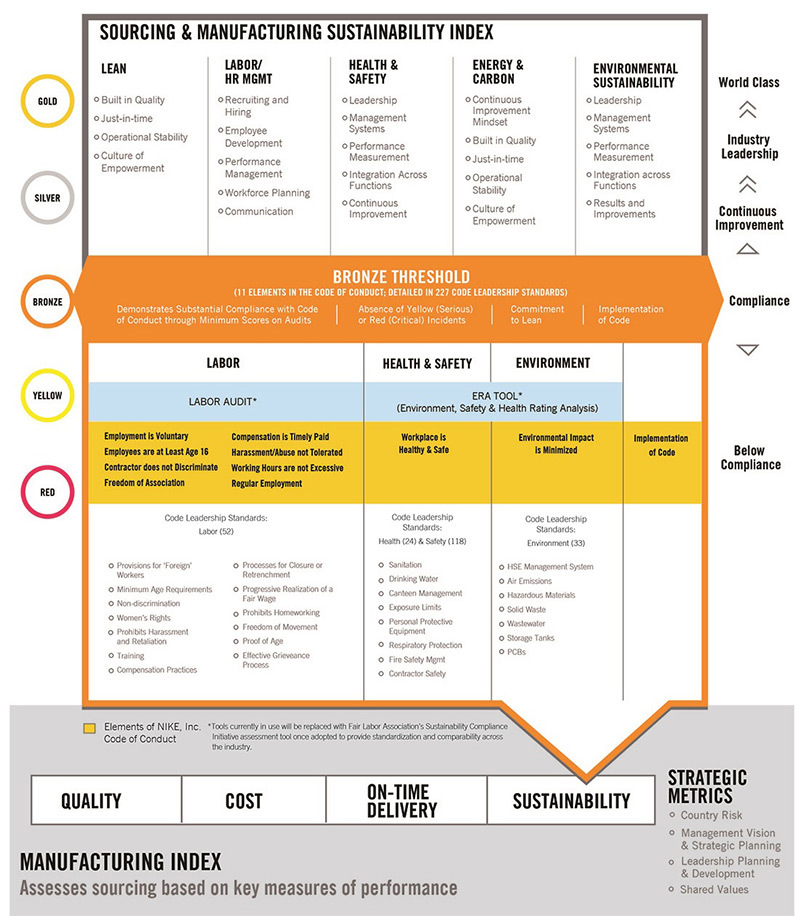
Nike's Sourcing & Manufacturing Sustainability Index. See their full report here.
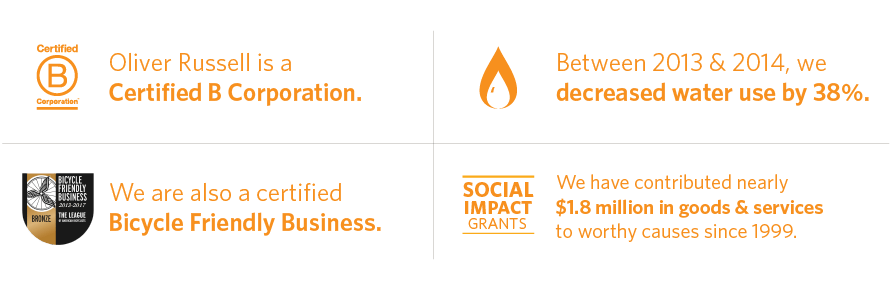
As part of a contract-renewal process, our longtime client Hewlett-Packard recently asked us to provide not only our policies for sustainability measures, but also for the performance data to support them. These were largely environmental, rather than social. We were able to answer affirmatively to this request by virtue of having gone through the B Corporation certification process.
I believe it’s coming to the broader B2B market shortly and will contemplate more than environmental issues, such as measures for transparency in reporting, community involvement, philanthropy, banking relationships, and governance, among other practices.
It won’t be a question of values alignment then, but one of quantifiable performance. The marketplace will have already compelled you to adopt policies so that you can check off the boxes, so that won’t be the issue. HOW you answer will be the important thing, as it will be scored and used to rate your attractiveness as a potential business partner.
Albeit in isolated instances, this nascent movement is also showing up in the public sector. It will eventually become a force that influences public contracts, as Federal state, and municipal governments will begin giving preference to purpose-driven companies that can document and verify their performance on social and environmental issues.
We all know how the big pendulum of money works. It’s powerful, and it swings both ways. Right now, it looks like it’s swinging the right way—up, up, up as a force for good. Try this on for size. In the big picture, social responsible investing accounts for more than $6 trillion; and in the micro market example, such as in our instance, it’s rewarding businesses for their adherence to intentional values.
To a guy who has worked with social responsibility at the core of his business for nearly a quarter century, that’s immensely gratifying
Blog
Can corporate values provide the mojo to propel productivity and profitability?
Blog
The new Whole Foods ad campaign tests the marketing power of shared values.
Blog
Values should shape actions. Duh.