How a Supportive Employer Eased My Transition to Working Mother
BLOG
BLOG

My husband and I found out we were expecting a baby in 2012. After the initial wave of surprise and excitement passed, we were forced to start considering the logistics of what this meant for our financial situation.
Like the majority of married households in the U.S., we depend on two-incomes. There was no way to change that reality in nine months. Plus, I mentally need to work. I knew that becoming a working mother was in my future—but I also knew that I wanted to be a hands-on parent. What I DIDN’T know was how much I would come to value my employer through this adventure into motherhood.
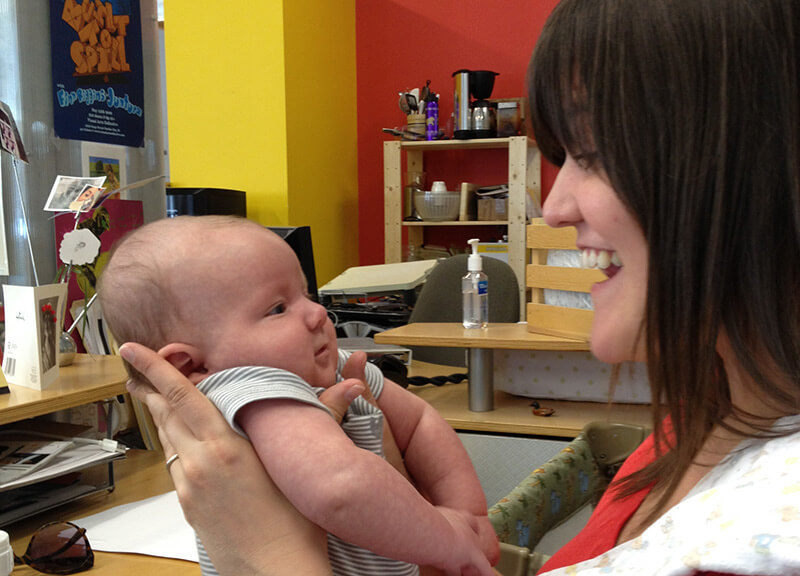
Shawna and Otto get some very important work done
I developed a serious complication during my pregnancy that required near-constant fetal monitoring and hospital bed rest starting at 31 weeks. Being an “ante partum” patient, locked in the maternity ward for more than a month was not part of my birth plan, but I wasn’t alone. There were a few other expectant mothers on the floor—but I quickly learned my situation was unique. While I was able to continue taking conference calls and returning emails from my hospital bed, the other working moms had to use their vacation days, quit their job, or start their maternity leave early—making it so they had less time to be with their newborns once they were delivered.
I learned that hospital bed rest was a very scary, lonely time for patients. Social workers were sent to visit us often, just to check in. With eight hours of my days filled with work, my time in the hospital passed (relatively) quickly with help from the routine and consistency it provided.
Once Otto arrived, my transition into motherhood was cushioned by the amazing reassurance that my employer belongs to an astoundingly scarce group of companies that offer paid maternity and paternity leave. Combined with a short-term disability policy, I had all 12-weeks of my maternity leave paid. Instead of fretting about finances, I was able to focus on caring for my premature son. This is a luxury 84% of working mothers in the U.S. are not allowed.1

Otto chilling on the desk—his normal spot from 3-7 months
The U.S. and Papua New Guinea are the only two countries2 that don’t guarantee women some amount of time off to care for a newborn. And don’t even get me started on our country’s mindset about paternity benefits! The Family Medical Leave Act (FMLA) is in place—requiring companies with 50+ employees to grant 12-weeks unpaid leave. Oliver Russell only had 10 employees on staff—and was not held to this mandate. Oliver Russell chooses to offer paid leave because it sees the business benefits of maternity leave.
After my maternity leave was over, Otto accompanied me to the office. I didn’t have to leave my newborn in someone else’s care. I am just going to pause a second here for that to sink in—there was a full-time baby at Oliver Russell for FOUR STAGGERING MONTHS.

New definition of a mobile worker.
That isn’t possible with many infants, but Otto was amazingly agreeable (I say ‘was’ because he is a toddler now. Nuff said!). He was content sitting on the conference room table during meetings, cooing at my co-workers during brainstorms, quietly attending conference calls, and was also able to take naps in an office with an open floor plan. I remember attending a video conference with another agency and having them remark “In all our years in this business, we have never had a baby go to a kickoff call.”
My industry is unique, my office is relaxed and accommodating, and my clients are mostly out-of-state. I am able to fulfill the vast majority of my work responsibilities over email or through conference calls. And Otto was able to be by my side until he was 7 months old. Many clients weren’t even aware that my son was in the office—but every client who heard about it (many of whom are also working moms) commented that they were proud to partner with a company that supported motherhood so completely.
My current work situation is still flexible. I work in the office two-days a week and work from home (with my son) the remainder of the time. While the days at home are exponentially more difficult than any day in the office, I am still so grateful to have this time with my son. I may have to finish a few conference calls holed-up in the bathroom with a toddler knocking (or screaming) at the door, but I get to be the one he is screaming at! I get to see his milestones happen—and I get to help support my family and grow my career at the same time.

Taking advantage of the relaxed dress code that comes with working from home.
Throughout my journey into becoming a working mother I have experienced nearly every flexible work situation you can imagine. I consider my working arrangement a privilege and I try to approach it as such. Here are a few pointers for someone hoping to set-up a flexible work situation:
Blog
Tackling one of life's biggest milestones as a responsible consumer requires research.
Blog
Our health and wellness benefit helps the team run the Toughest Race in the Northwest.
Blog
Bicycles are good for business - ride on!