3 Mistakes to Avoid When Marketing Your Health Insurance CO-OP
BLOG
BLOG

We’ve learned a lot from our experience marketing health insurance CO-OPs to health care consumers. Unlike typical health insurance companies, health insurance CO-OPs (Consumer Oriented and Operated Plans) are non-profit organizations in which the same people who own the company are insured by the company. Legally, their profits must be used to lower premiums and expand benefits for members.
If you’re a marketing director starting your marketing plan for the fall 2015 Open Enrollment period, we’d like to share three common mistakes to avoid:
Recently, I reviewed the websites of some of the top health insurance providers across the country. One thing I noticed immediately was the heavy use of stock photography. Nothing but a sea of smiling faces. This type of photography is generic and not believable to consumers.
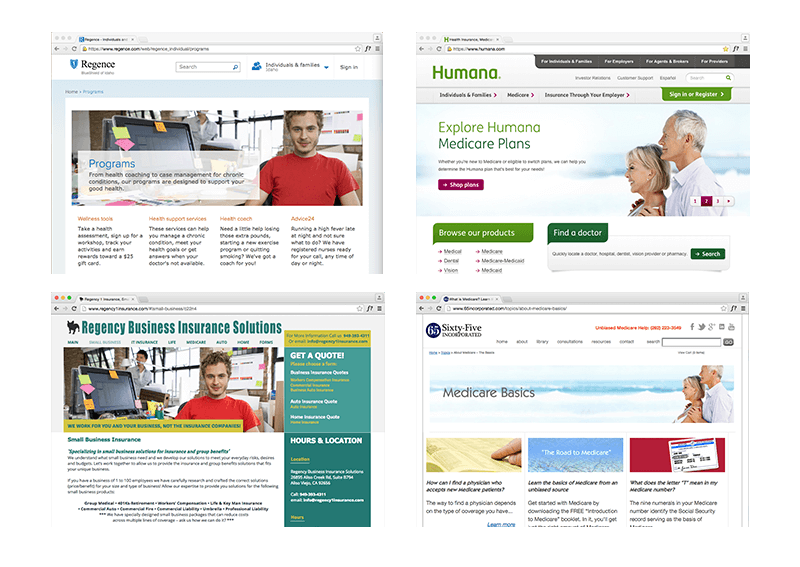
Duplicates of the bland stock photography found on many leading heath insurance websites can be seen elsewhere around the web.
When we set out to build the brands for Mountain and Montana Health CO-OPs, it was clear that what they were setting out to do—offering new and unique health insurance that is “by the people, for the people”—was different. We wanted the brand visuals to communicate that clearly and honestly. Our idea? User-generated photos. Since the CO-OPs are both run and operated by members, we wanted them to be represented in the visuals. We collected photos from members in Idaho and Montana to populate everything from the website to outdoor boards. This option not only helped MHC break free from the competitive landscape visually, but also provided a cost-effective way to quickly build an image library of photos relevant to the lives and environments of their target audience while providing a fun and engaging way to encourage participation from members.
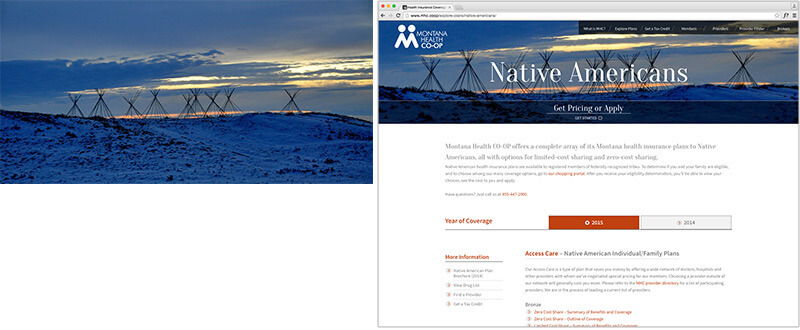
An example of a photo submission from Kitty Kolden that she took in Oswego, Montana, compared to how we used her photo as a header image on the MHC website.
Health insurance can be very confusing. So when a potential member visits your website to find out more about you, it certainly doesn’t help when they land on a homepage with 50 different links. Or when you give them a 30-page brochure about every detail for every plan you offer. Or when you try to cram way too much information into a 30-second radio spot. The best thing you can do for members is to keep your information concise, organized, and easy to understand. As we develop campaign materials for health insurance companies, we often take a step back to consider whether what we’re building is easy to understand and makes sense to us as individuals. (We also put our friends and family through the same ringer—how lucky for them!)
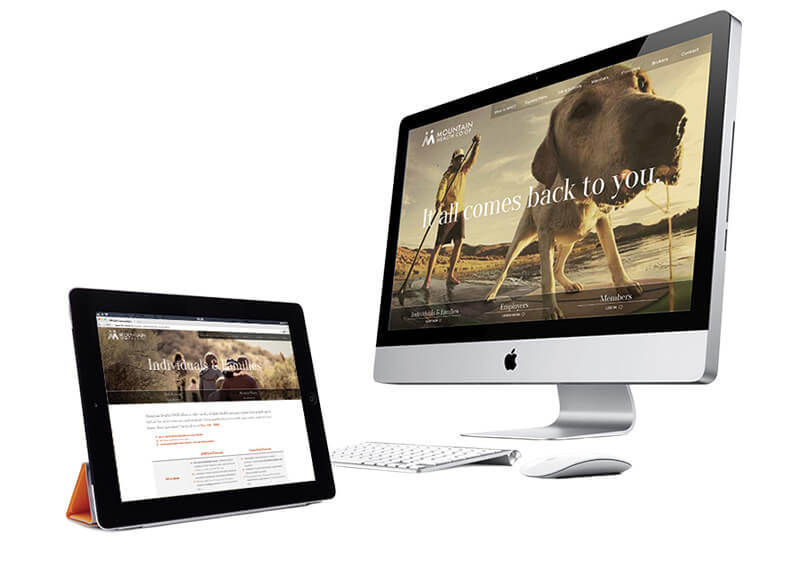
MHC's responsive website features all user-generated photos.
When we designed the homepage for Mountain and Montana Health CO-OP, we kept just three links above the fold (beyond the standard top navigation)—Individuals and Families, Employers, and Members. We wanted to make it very easy for each site visitor to know where to click to quickly find the information they need. We treated the sales literature in a similar fashion—condensing dozens of individual plan brochures down to a single, printed piece that displays all of MHC’s plan details in a single view, making side-by-side comparisons much easier.
Co-insurance. Copayment. Deductible. Outline of Coverage. Standard PPO. Whether potential members are trying to learn more or current members are trying to understand their coverage, this language can be very confusing. Help make it easier for these users to navigate the choppy waters of health insurance verbiage in your marketing efforts—whether it’s through the use of glossaries in sales literature or tooltips that automatically pop up when users hover over specific words on your website. The more informed your members and prospective members are, the more they’re able to make better decisions about their health insurance.
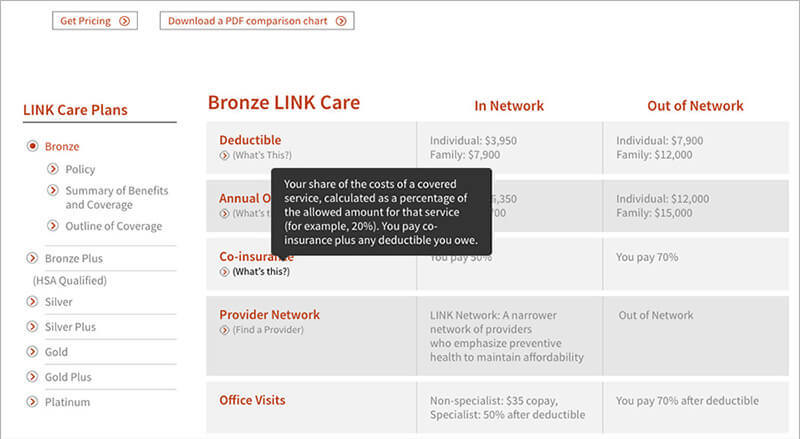
An example of the tooltip pop-ups that appear when users hover over specific words and phrases on the MHC sites.
These are just three things we’ve learned from marketing health insurance CO-OPs; we’d be happy to share other lessons with you. If you’re interested in learning more, you can email me at abartron@oliverrussell.com. Additionally, you can read our full MHC case study here.
Blog
A new client uses an age-old business model to bring some sanity to insurance premiums.
Blog
When you're introducing a new health insurance concept, it pays to keep it simple.
Blog
When companies collaborate on content with consumers, both groups win.